The Phantom Display: Rescuing Laptops from the Black Screen of Death
Revive laptops stuck with a black screen and spinning fans. Learn how to restart graphics drivers and perform a hard static discharge reset safely.

Embedded Controller (EC) Power Reset & Modern Standby Docking Fix Guide
6 min. read
The Ticket: The Monday Morning Docking Disaster
A hybrid worker just arrived at their home office after a weekend of traveling. They plug their laptop into the USB-C docking station and press the power button. The keyboard backlight illuminates, the fans spin up to a high RPM, but the monitors remain completely black. They unplug the dock to check the built-in laptop screen, but that is dead too. The machine refuses to wake up and refuses to shut down. We need to execute a physical hardware override to break the power lock without opening the chassis.
Pre-Flight Check
- Permissions: Physical access to the laptop.
- Tools: None required.
- Impact: Moderate. Forcing a hard reset will instantly terminate the active Windows session. Any unsaved documents or applications running before the machine went to sleep will be lost.
[!WARNING] The Risk Factor: Users often mistake a sleeping laptop for a completely powered-off laptop. Instructing a user to hold the power button down on a machine that is actually in the middle of a silent background Windows Update can corrupt the boot sector. Always look for a blinking sleep indicator light before proceeding.
The Solution: The Graphics Kick and the Hard Reset
1. The Graphics Driver Kick
Before killing the power, try to wake the display subsystem.
- Ensure the laptop is open.
- Press the Windows Key + Ctrl + Shift + B simultaneously.
- If the system is responsive, you will hear a short beep and the screen will briefly flicker as Windows attempts to restart the display driver. If the screen wakes up, you are done. If it remains black, proceed to step 2.
2. The Hard Static Discharge
If the hotkey fails, the motherboard's power controller is deadlocked.
- Disconnect the laptop from the docking station.
- Unplug the OEM power adapter.
- Remove all peripheral devices (USB flash drives, wireless mouse receivers, headsets).
- Press and hold the physical power button down for a full 30 to 40 seconds. Ignore any lights that turn off after 5 seconds; keep holding the button.
- Release the power button.
- Plug the OEM power adapter directly into the laptop (do not use the dock yet).
- Press the power button once to turn the machine on.
The "Why" (Root Cause)
Why does a laptop get trapped in this zombie state? The blame almost entirely falls on "Modern Standby" (also known as the S0 Low Power Idle state).
In traditional sleep states, the laptop powers off the CPU and dumps the active session into RAM. Modern Standby attempts to treat the laptop like a smartphone, keeping the network card and background processes barely trickling with power to fetch emails while asleep. When a user undocks a laptop while it is in Modern Standby, the graphics driver gets severely confused. Upon waking up, the driver tries to route the video signal to a ghost DisplayPort connection that no longer exists, leaving the internal screen completely dark.
Under the Hood (Technical Deep Dive)
What exactly does holding the power button for 40 seconds accomplish? It resets the Embedded Controller (EC).
The EC is a specialized microchip on the motherboard that operates completely independently from the Intel or AMD CPU. It controls low-level hardware functions like keyboard inputs, battery charging, thermal sensor monitoring, and power state routing. When the EC crashes or gets stuck in a logic loop, the operating system is utterly helpless.
By removing all external power sources and holding the power button down for an extended period, you are forcing the motherboard to drain the residual capacitance in the EC circuits. This physically starves the chip of voltage, forcing it to clear its hung state, forget the corrupted power profile, and perform a clean cold boot initialization.
RMM & Automation Tips
You cannot deploy a script to a machine that is offline and unresponsive. However, you can proactively stop this from happening across your fleet.
- Firmware Baselines: This issue is heavily tied to outdated BIOS versions and buggy OEM dock firmware. Use your RMM to silently push BIOS updates and dock firmware patches (like the Dell Command Update CLI or Lenovo System Update tool) on a strict monthly schedule.
- Disable Fast Startup: The Windows "Fast Startup" feature often conflicts with Modern Standby. Deploy a registry key via RMM to disable it globally:
Set-ItemProperty -Path "HKLM:\SYSTEM\CurrentControlSet\Control\Session Manager\Power" -Name "HiberbootEnabled" -Value 0
Troubleshooting & Edge Cases
- Edge Case 1: The Dim Screen. After the reset, look very closely at the black screen or shine your phone flashlight directly onto the glass. If you can faintly see the Windows login screen, the laptop is not hung. The motherboard's backlight inverter has suffered a physical hardware failure.
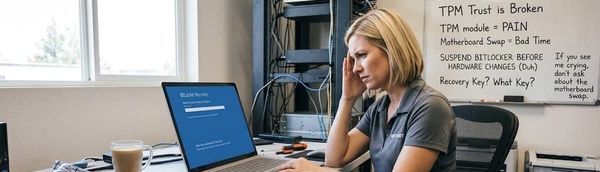
- Edge Case 2: BitLocker Lockout. Hard resetting the Embedded Controller alters the hardware state temporarily. When the machine finally boots, the TPM (Trusted Platform Module) may detect the ungraceful shutdown and demand the 48-digit BitLocker Recovery Key to unlock the drive. Have the key ready in your IT documentation before you instruct the user to hold the power button.